
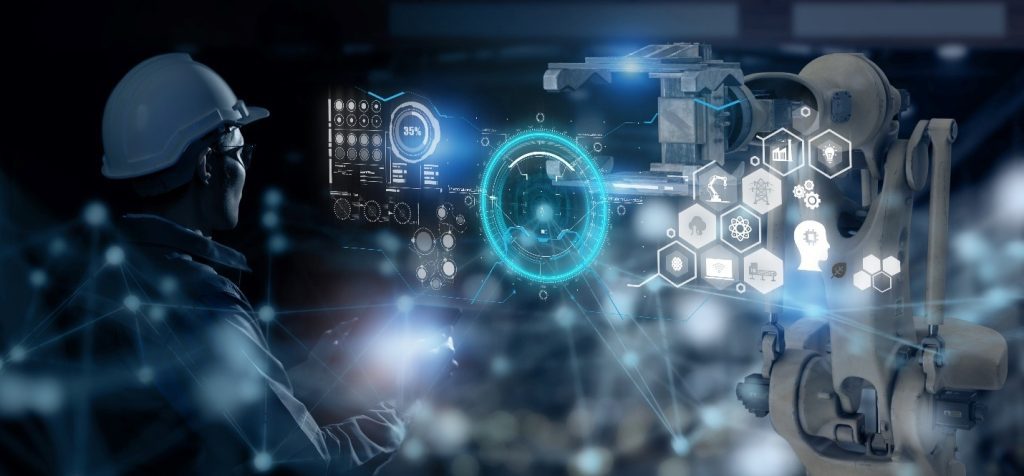
We live in environments called VUCA (Volatility, Uncertainty, Complexity and Ambiguity). In these environments, it is especially relevant to anticipate the future and explore the effect that other actions can have on that future.
A digital twin is a tool that allows the use of a new or unknown method without risk and at a low cost to check that what you are going to implement will work.
Industry 4.0 technologies give us the tools to provide timely responses by enabling adaptation versus volatility, collaboration versus uncertainty, and ensuring decisions from complex environments’ data and anticipation versus ambiguity.
The Internet of Things (IoT), artificial intelligence and augmented reality are some of the technologies that have driven the development of digital twins, revolutionizing the way businesses operate.
In this context, a digital twin can be helpful. A digital twin is a virtual and dynamic replica of a physical system that receives real-time data captured through sensors. A digital twin can cover the entire life cycle of a product from design and manufacturing to how the product behaves during operation and maintenance.
A digital twin can represent objects, people, places or processes. Digital twins can be developed for daily objects, such as a car or a cell phone. Likewise, digital twins can be developed for companies to improve the representation and management of their operations. We could even create digital twins of cities to upgrade their infrastructures and functions.
How to Identify the Opportunity to Use a Digital Twin?
There are several elements whose concurrence can be a cause for the adoption of a digital twin to improve the management of our systems, such as the following:
- It exists a product, system or physical process on which its digital counterpart is based.
- There is connectivity and information flow between physical and digital entities.
- There is the ability to store and track data across a network or system.
- Real-time synchronization is available.
- The physical entity, its characteristics and performance levels can be simulated.
- It is possible to predict and prescribe features to make it more efficient.
- The operations of the physical twin can be monitored, maintained and improved.
Why is There a Growing Interest in Digital Twins?
According to Accenture’s “Technology Trends 2022” report, the global digital twins market is expected to reach $184.5 billion by 2030.
In such a complex environment, it is logical that the digital twins have gained special relevance and have become key actors in the digital transformation. The need for companies to generate competitive advantages means that they are increasingly attracted by their benefits:
- Resilience
The digital twin is a simulation environment that allows different alternatives to be explored before making a decision, improving adaptability by minimizing risks, time and costs.
- Efficiency
The digital twins are fed by real-time data, allowing you to improve the effectiveness and efficiency of your systems now and in the future. By providing a comprehensive view, the impact that decisions have on each element of the system can be assessed.
- Customer orientation
In the current context, people actively demand more information and better service. Through the data provided by digital twins, a more personalized service can be offered, anticipating their wishes and requirements.
- Sustainability
Through simulations and scenario analysis, predictive modelling and operational efficiency, digital twins allow organizations to better manage their infrastructure and resources, simulate emissions, and optimize supply and transportation networks.
Digital Twins Have Applications in all Industries
The concept of the digital twin is very broadly applicable. While they were originally developed for testing prototypes and optimising production processes, they have now penetrated all types of organisations and the application possibilities seem limitless. Current trends are mainly in:
Manufacturing
Digital twins appear throughout the product lifecycle. During product development, they enable product feasibility testing before manufacturing, reducing defects and time-to-market. They also make it easier for companies to offer more personalised products and services to their customers. They can also be used to monitor and analyse the quality of finished products. Finally, they can predict potential machine downtime to minimise maintenance activities and take action before they fail.
Logistics
Digital twins are widely used to determine the viability of packaging materials by predicting their behaviour, thereby improving the safety of shipments. On the other hand, by testing warehouse layouts, the most efficient one can be chosen to maximise operational performance, as well as designing distribution routes and inventory location based on real-time traffic and road information.
Retail
Digital twins make retailing smoother for both suppliers and customers. Suppliers benefit from optimal inventory management and sales floor layout. As for customers, personalised solutions can be offered to enhance their experience.
Health Industry
Digital twins can help healthcare companies identify ways to improve and speed up processes, enhance the patient experience and reduce costs. On the other hand, it can also boost personalised medicine through the analysis of the patient’s genome, physiological characteristics and lifestyle.
Construction sector
A digital twin can help construction companies understand the performance of a building in real-time, allowing them to adjust performance to optimise efficiency. The data collected from the digital twin can be used to plan and design future buildings.
The Future of Digital Twins
We are just scratching the surface of the enormous possibilities offered by the digital twins to extract value from all data that comes from digitising processes and sensitising infrastructure. As the doors open for digital twins to penetrate all areas of an organisation – human resources, finance, supply chain – the positive impact will be comprehensive and the benefits significantly increased.